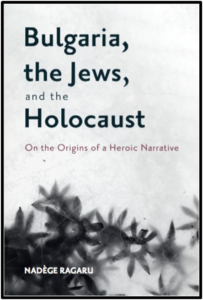
– Parution – Bulgaria, the Jews and the Holocaust
Permettez-moi de vous faire part de la publication en anglais de mon ouvrage dédié aux savoirs sur la Shoah en Bulgarie et à leurs usages (originellement édité aux Pressses de Sciences Po en octobre 2020).
Le texte a été actualisé pour tenir compte des évolutions récentes dans les politiques de l’histoire en Bulgarie. Les échos avec d’autres configurations en Europe et au-delà où l’histoire de la Shoah est placée au services d’agendas politiques, sont sensibles — douloureusement.
L’ouvrage est en Open Access.
Bien à vous,
Nadège Ragaru
Nadège Ragaru, *Bulgaria, the Jews and the Holocaust. *
*On the Origins of a Heroic Narrative*
Rochester Studies in East and Central Europe Series
(Series Editor Timothy Snyder, Yale University)
Rochester, N.Y.: University of Rochester Press, 2023
Translated by Victoria Baena and David A. Rich
[image: Bulgaria, the Jews and the Holocaust.png]
Available as *an Open Access eBook* under the Creative Commons license CC BY-NC-ND at: openaccess.boydellandbrewercms.com/publications/-269869/bulgaria-the-jews-and-the-holocaust
Available on Paperback at:
boydellandbrewer.com/9781648250705/bulgaria-the-jews-and-the-holocaust/
$39.95 / £29.99 (with 35% off if you use the code BB135 ; see also the flyer below the book jacket image)
*Presentation*
A profoundly original historical inquiry, this work offers a critical reflection on the silences of the past and the remembrance of the Holocaust.
During World War II, even though Bulgaria was an ally of the Third Reich, it never deported its Jewish community. Until recently, this image of Bulgaria as a European exception has prevailed—but at a cost. For it ignored the roundup of almost all the Jews living in the Yugoslav and Greek territories under Bulgarian occupation between 1941 and 1944, who were in fact deported to Poland, where they were murdered.
In this new English translation of her work originally published in French, Nadège Ragaru presents a riveting, wide-ranging archival investigation encompassing 80 years and six countries (Bulgaria, Germany, the United States, Israel, North Macedonia and Serbia), in doing so exploring the origins and perpetuation of this heroic narrative of Bulgaria’s past. Moving between legal and political spheres, from artistic creations to museum exhibits, from the writing of history to transnational public controversies, she shows how the Holocaust north of the Danube became a « rescue » to the river’s south. She traces how individual merits were turned into « national » achievements, while blame for the deportations was planted squarely on Nazi Germany. And she illuminates how discussions on the Holocaust in Bulgaria were held hostage to Cold War dynamics before 1989, only to yield to political and memorial struggles afterwards. Ultimately, she restores Jewish voices to the story of their own wartime suffering.
*Endorsements*
“Meticulously researched and beautifully written, Dr. Nadège Ragaru’s *Bulgaria, the Jews, and the Holocaust: On the Origins of a Heroic Narrative *should put to rest once and for all the myth of the World War II Bulgarian government as the altruistic savior of Bulgarian Jewry. Using print, visual, and sound sources from numerous countries, Dr. Ragaru analyzes and demonstrates how the perceptions—some intentionally erroneous—of what happened during World War II have been created and transmitted over the course of the past 78 years. This includes the deliberate downplaying if not utter omission in the Bulgarian historical canon of the fact that Bulgarian troops and police proactively rounded up and deported 11,343 Jews from Bulgarian-occupied territories to their death in the Nazi Treblinka death camp.”
*—Menachem Z. Rosensaft, adjunct professor of law, Cornell Law School; General Counsel Emeritus, World Jewish Congress *
“The Bulgarian state both persecuted and rescued Jews during World War II. Neither narrative is complete without acknowledgement of the other. In a highly original volume, Nadège Ragaru traces the evolution of two divergent narratives across geographical, chronological, and ideological space from the events in 1943 to the present. Using diverse venues, historical scholarship, criminal trials, contemporaneous deportation footage, fictional film, museum representation, and political debate, she reveals how regional, national, European, and global politics impacted the narratives within Cold War and post-communist frameworks and suggests guidance for responsibly integrating them without sacrificing awareness of individual agency in persecuted and persecutor.”
*—Peter Black, historian and consultant *
“This powerful book traces Bulgaria’s difficult path toward accounting for its contradictory implication in the Holocaust: while Bulgarian authorities helped the Germans to murder the Jews from its occupied territories, a diverse coalition managed to prevent the deportation of Jews from pre-1941 Bulgaria. Ragaru provides a nuanced, exhaustively researched analysis of the interplay between silencing and selectively articulating the memory of these events. A must-read that highlights the centrality of the Holocaust and its (non)memory for Bulgaria’s twentieth-century history.”
*—Ulf Brunnbauer, director of the Leibniz Institute for East and Southeast European Studies, Regensburg *
— *Nadège Ragaru* *Research Professor* [image: Sciences Po] 28, rue des Saints Pères, 75006 Paris, France
www.sciencespo.fr/ceri/fr/users/nadegeragaru
*https://sciences-po.academia.edu/Nad%C3%A8geRAGARU <sciences-po.academia.edu/Nad%C3%A8geRAGARU>*
*https://www.researchgate.net/profile/Nadege-Ragaru <www.researchgate.net/profile/Nadege-Ragaru>*
*FARIBA, enfin libre!*
*https://faribaroland.hypotheses.org/ <faribaroland.hypotheses.org/>*